
Written by Michelle Garcia, RN | Founder, EmpowerHUB Tech65
Updated September 11, 2026
A strong new client onboarding process helps coaching clients move from “yes, I want to work with you” to “I know exactly what happens next.” For coaches, it reduces back-and-forth admin, prevents confusion, and creates a consistent client experience from the first paid engagement through the first session and beyond.
This guide walks through a practical coaching client onboarding workflow you can adapt for life coaching, business coaching, wellness coaching, career coaching, or similar service-based coaching offers. You’ll learn what to send, when to send it, what each onboarding stage is for, and how to keep the process clear without overwhelming your client.
What should happen after a prospect says yes?
After a prospect decides to work with you, your onboarding process should confirm the engagement, formalize expectations, collect payment if applicable, gather essential client information, share welcome materials, explain scheduling and communication, prepare for the first session, and follow up once onboarding is complete. In other words, new client onboarding turns interest into a structured coaching relationship.
A repeatable process matters because clients are often excited but unsure. If they receive a scattered mix of links, forms, emails, and instructions, they may hesitate or miss key steps. A clear client onboarding for coaches workflow gives them confidence while saving you from rewriting the same instructions for every client.
Build your coaching client onboarding workflow step by step
The best onboarding workflows are simple, repeatable, and easy to personalize. You do not need a complicated automation system to start. You need a clear sequence, a few essential documents, and a reliable way to guide the client from one step to the next.
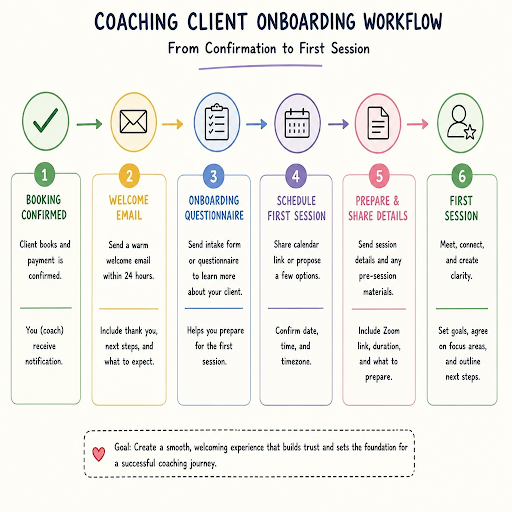
Use the following numbered steps as a foundation for your own coaching client onboarding workflow.
1. Confirm the engagement in writing
The first step is to confirm that the prospect has decided to move forward. This can be a warm email, direct message, or booking confirmation, depending on how you normally communicate. The goal is to acknowledge their decision and clearly state what will happen next.
Your confirmation message should include the coaching offer they selected, the next action they need to take, and a brief overview of the onboarding sequence. This prevents the client from wondering whether they are officially booked, whether they need to pay first, or whether they should wait for more information.
A simple confirmation message might include:
- A thank-you note for choosing to work with you
- The name or type of coaching package they selected
- A short list of next steps, such as agreement, payment, intake form, and scheduling
- The expected timeline for completing onboarding
- A reminder that they can ask questions before signing or paying
This stage sets the tone. It shows that your coaching relationship will be organized, thoughtful, and client-centered from the beginning.
2. Send the coaching agreement
The coaching agreement is the formal document that defines the working relationship. It usually outlines the scope of coaching, session structure, payment terms, boundaries, cancellation policies, confidentiality expectations, and each person’s responsibilities. If you use contracts or legal documents in your business, make sure they are appropriate for your location and coaching practice.
The purpose of this stage is clarity. A coaching agreement helps prevent misunderstandings before they happen. It allows the client to review what they are committing to and gives you a shared reference point if questions come up later.
When you send the agreement, do not just attach a document with no context. Tell the client what it is, why it matters, and what they need to do with it. For example, you might say: “Please review and sign the coaching agreement before your first session. It explains how we’ll work together, including scheduling, communication, and cancellation expectations.”
Keep the instruction simple. If the agreement requires an electronic signature, say so. If the client should reply with questions before signing, invite them to do that. This makes the process feel professional rather than intimidating.
3. Collect payment when applicable
If your coaching package requires payment before sessions begin, collect it early in the onboarding process. This may happen before or after the agreement is signed, depending on your business model. What matters is that the client understands when payment is due and what access or scheduling depends on it.
The purpose of this stage is to remove uncertainty around the business side of the coaching relationship. Clear payment instructions reduce awkward follow-ups and help you avoid starting a coaching engagement without the required financial commitment in place.
Your payment message should include:
- The amount due or payment option selected, if already agreed
- The payment deadline or due date, if relevant
- A secure payment link or invoice
- What happens after payment is completed
- Who to contact if there is a payment issue
Avoid overexplaining your full billing system unless the client needs those details. Give them the exact action to take and reassure them that the next onboarding step will follow.
4. Send the intake form
The intake form helps you understand the client before the first coaching session. For life coach client onboarding, this might include goals, current challenges, personal values, areas of focus, previous coaching experience, preferred support style, and practical details such as time zone or availability.
The purpose of the intake form is preparation. It allows you to enter the first session with context instead of spending the entire conversation collecting background information. It also gives the client a chance to reflect on what they want from coaching before the work begins.
A useful intake form may ask about:
- The client’s main goals for coaching
- What prompted them to seek support now
- Current obstacles, patterns, or concerns
- What success would look like for the engagement
- Preferred communication or accountability style
- Any important context the coach should know before session one
Keep the form focused. A long intake form can feel like homework before the relationship has even started. Ask for what you genuinely need to prepare well, and save deeper exploration for the session itself.
5. Send welcome and onboarding materials
Once the agreement, payment, and intake steps are underway, send your welcome and onboarding materials. This is where a Client Welcome Pack can be especially useful. It gives clients one organized place to understand how the coaching experience works, what to expect, and how to get the most from the process.
The purpose of this stage is orientation. New clients should not have to guess how to prepare, where to book, what communication method to use, or how to handle schedule changes. Your welcome materials should answer the most common questions before they need to ask.
Your Client Welcome Pack might include:
- A warm welcome message
- An overview of your coaching approach
- What the client can expect from sessions
- How to prepare for coaching calls
- Communication boundaries and response times
- Scheduling or rescheduling instructions
- Links to forms, booking pages, or client portals
- A reminder of important policies already covered in the agreement
The Client Welcome Pack is only one part of the broader onboarding process. It should not replace your agreement, intake form, or direct communication. Instead, it supports those pieces by making the client experience feel organized and easy to follow.
6. Explain scheduling procedures clearly
Scheduling is one of the most common places where client onboarding becomes confusing. A client may not know whether you book sessions for them, whether they should use a calendar link, how often sessions occur, or what to do if they need to reschedule.
The purpose of this stage is to make session logistics effortless. When scheduling expectations are clear, clients are less likely to miss appointments, book the wrong session type, or send multiple messages asking what to do next.
Explain:
- How the first session will be scheduled
- Whether sessions are booked one at a time or in advance
- Which calendar link or booking tool to use
- How much notice is needed for changes
- Whether reminders will be sent automatically
- What to do if the client cannot find a suitable time
If you use a booking link, test it before sending it. Outdated links create friction and can make a polished onboarding process feel unreliable.
7. Set communication expectations
Communication expectations protect both the client and the coach. Clients need to know where to contact you, what kind of support is included between sessions, and when they can expect a response. Coaches need boundaries that prevent the relationship from becoming scattered or unsustainable.
The purpose of this stage is alignment. It helps clients understand how to get support without guessing whether to email, message, use a portal, or wait until the next session.
You may want to clarify:
- Your preferred communication channel
- Typical response time
- What is appropriate to send between sessions
- Whether voice notes, texts, or direct messages are included
- How urgent messages are handled
- Where clients should send completed forms or reflections
Use warm but firm language. For example: “For coaching-related questions between sessions, please email me rather than sending messages across multiple platforms. This helps me keep your support organized and respond thoughtfully.”
8. Prepare for the first coaching session
Before the first session, review the signed agreement, payment status, intake form, and any notes from the sales or discovery conversation. This preparation helps you begin with focus instead of scrambling to understand the client’s background.
The purpose of this stage is to create a strong first-session experience. The client should feel that you remember why they came to you and that the session has a clear direction. You do not need to plan every moment, but you should know the client’s stated goals, priorities, and any sensitive topics they shared.
Your preparation may include:
- Reviewing the client’s intake responses
- Noting their top goals or challenges
- Preparing opening questions for the first session
- Checking that the meeting link works
- Confirming the session time and time zone
- Identifying any missing onboarding items
If something is missing, follow up before the session if possible. A short reminder is better than discovering during the call that the client never completed an important form or could not access the meeting link.
9. Welcome the client into the first session
The first session is not only a coaching conversation. It is also the moment when the client experiences whether your onboarding promises match reality. Begin by creating a calm, clear environment and briefly confirming how the session will work.
The purpose of this stage is to help the client feel grounded. Even highly motivated clients may arrive nervous, uncertain, or overloaded. A simple opening structure can make the session feel safe and productive.
You might start by:
- Welcoming the client and acknowledging the start of the coaching relationship
- Confirming the session length and format
- Briefly reviewing what they shared in the intake form
- Asking what feels most important to focus on today
- Clarifying how goals, action steps, or reflection will be handled
Avoid spending the whole session re-explaining every onboarding detail. If your workflow has done its job, the first session can focus on the client’s goals rather than administrative cleanup.
10. Follow up after onboarding
Onboarding should not end the moment the first session is booked. A short follow-up helps confirm that the client has everything they need and gives you a chance to catch small issues before they become ongoing friction.
The purpose of this stage is continuity. It reinforces the client’s decision, helps them stay engaged, and gives you feedback on whether your onboarding process is working.
Your follow-up may include:
- A brief thank-you or welcome reminder after the first session
- A recap of any next steps or agreed actions
- A reminder of where to book or access future sessions
- A link to any shared resources or client portal
- A gentle prompt to ask questions if anything feels unclear
You can also track your own observations. Did the client know where to go? Did they complete the intake form on time? Did they ask questions that your welcome materials should have answered? Use that information to improve your onboarding workflow.
Keep your core onboarding documents in clear roles
Your coaching agreement, intake form, and Client Welcome Pack work together, but they should not do the same job. When each document has a distinct purpose, onboarding feels lighter and more organized.
The coaching agreement defines the professional relationship. It covers expectations, policies, responsibilities, and terms. It is the document clients review when they need to understand the formal structure of working with you.
The intake form gathers client-specific information. It helps you prepare for coaching by learning about the client’s goals, challenges, preferences, and context. It should be practical, focused, and directly useful for the first session.
The Client Welcome Pack or onboarding guide helps the client navigate the experience. It explains how coaching works, how to schedule, how to communicate, and how to prepare. Together, these three pieces create a smoother transition from new client onboarding to active coaching.
Example client onboarding checklist for coaches
Use this simple client onboarding checklist as a starting point, then adjust it for your coaching model, tools, and policies.
- Send confirmation message
- Thank the client for choosing to work with you.
- Confirm the coaching package or next step.
- Give a short overview of what they will receive next.
- Send coaching agreement
- Explain what the agreement covers.
- Include signing instructions.
- Invite questions before the client signs.
- Collect payment if required
- Send invoice or payment link.
- Clarify the due date or payment sequence.
- Confirm what happens after payment is complete.
- Send intake form
- Ask only for information you will use.
- Give a completion deadline before the first session.
- Include a contact point for technical issues.
- Send Client Welcome Pack
- Share your coaching process and expectations.
- Include scheduling, communication, and preparation guidance.
- Keep links organized and easy to find.
- Schedule the first session
- Provide a booking link or confirm the time manually.
- Check time zones and meeting links.
- Explain rescheduling procedures.
- Prepare internally
- Review signed documents and intake responses.
- Note goals, concerns, and first-session priorities.
- Confirm no required steps are missing.
- Send a pre-session reminder
- Confirm date, time, and meeting link.
- Remind the client how to prepare.
- Keep the message brief and reassuring.
- Hold the first session
- Welcome the client.
- Confirm focus and expectations.
- Begin coaching with a clear direction.
- Follow up after onboarding
- Recap next steps.
- Remind the client where to find resources.
- Note any process improvements for future clients.
Common client onboarding mistakes to avoid
A good onboarding process does not need to be fancy, but it does need to be clear. The most common mistakes usually happen when coaches assume the client understands more than they actually do.
Sending too many documents at once without instructions
If you send an agreement, invoice, intake form, calendar link, welcome guide, and extra resources in one message with no order of priority, clients may freeze. They may complete the easiest item first and miss the most important one. Break the process into a clear sequence or include a numbered action list.
Leaving the next step unclear
Every onboarding message should answer: “What do I do now?” If the client has to search through paragraphs to find the action, the process becomes harder than necessary. Use plain instructions such as “Please sign the agreement first, then complete the intake form by Friday.”
Communicating inconsistently
If one client gets a polished welcome email and another receives a rushed message with missing links, the experience becomes inconsistent. A repeatable workflow helps every client feel equally supported. It also reduces the mental load of deciding what to send each time.
Missing forms or agreements
Starting coaching without the required agreement, payment, or intake form can create confusion later. You may lack important context, and the client may not fully understand expectations. Keep a simple tracking system so you can see what has been completed before the first session.
Using outdated links
Old booking links, expired payment links, incorrect meeting URLs, and outdated resource pages create unnecessary friction. Review your onboarding materials regularly, especially if you change scheduling tools, email addresses, forms, or packages.
Making scheduling procedures vague
Clients should not have to ask whether they book sessions themselves or wait for you. Unclear scheduling can delay the start of coaching and create avoidable back-and-forth. Include the exact booking process in your welcome materials and reminder emails.
Overwhelming clients with unnecessary information
More information does not always mean a better experience. If you send long guides, multiple videos, unrelated resources, and detailed explanations before the first session, the client may feel overloaded. Share what they need now, then provide deeper resources when they become relevant.
Make the process repeatable without making it impersonal
A repeatable client onboarding process is not about sounding robotic. It is about creating a dependable structure so you can focus your personal attention where it matters most. When the administrative steps are organized, you have more space to listen, prepare, and coach well.
Templates, checklists, and saved email drafts can help you reduce admin work. They also prevent missed steps and ensure clients receive the same essential information. You can still personalize the welcome note, reference the client’s goals, and adapt the first-session preparation to their situation.
A practical approach is to standardize the structure and personalize the relationship. Keep the agreement, payment process, intake form, scheduling instructions, and welcome materials consistent. Then customize the tone, examples, and coaching focus based on the individual client.
Strengthen your onboarding materials with the EmpowerHUB Client Welcome Pack
If you want a more polished way to welcome clients without building everything from scratch, the EmpowerHUB Client Welcome Pack can support your onboarding process. It is designed to give coaches professionally structured onboarding content that helps clients understand what to expect and how to begin confidently.
The resource includes a ready-to-use PDF as well as an editable Canva version, so you can customize the design, language, and branding for your own coaching practice. Use it as part of your larger onboarding workflow alongside your coaching agreement, payment process, intake form, scheduling steps, and follow-up communication.
To make your new client onboarding feel more organized and client-friendly, explore the EmpowerHUB Client Welcome Pack and adapt it to your coaching process.
Frequently asked questions
How do you onboard coaching clients without overwhelming them?
Use a clear sequence and avoid sending everything with equal importance. Tell clients which step comes first, what each document is for, and when each item is due. Keep your welcome materials focused on what they need before the first session, then share extra resources later.
What should be included in client onboarding for coaches?
A complete onboarding process usually includes a confirmation message, coaching agreement, payment instructions when applicable, intake form, welcome or onboarding materials, scheduling instructions, communication expectations, first-session preparation, and a follow-up. The exact details depend on your coaching model, but the client should always know what to do next.
When should I send the Client Welcome Pack?
Send the Client Welcome Pack after the client has agreed to work with you and once the formal onboarding steps are in motion. Many coaches send it after the agreement and payment instructions, or alongside the intake form. The key is to provide enough context without burying the client in too many tasks at once.
How can I improve my coaching client onboarding workflow over time?
Review the questions clients ask during onboarding. If several clients ask where to book, how to prepare, or where to find a link, your materials may need clearer instructions. Update your checklist regularly and remove any outdated links, unnecessary resources, or confusing steps.
Final onboarding tips for a smoother client experience
The best onboarding process is easy to follow, repeatable, and human. It gives clients confidence that they made the right decision while helping you stay organized behind the scenes.
Before your next new client begins, review your workflow and ask:
- Does the client know exactly what happens after saying yes?
- Are the agreement, payment, intake, and welcome steps clearly separated?
- Are scheduling and communication expectations easy to find?
- Are any links, forms, or instructions outdated?
- Is the process helpful without being overwhelming?
When your onboarding is clear, your coaching relationship starts with less confusion and more trust. That foundation makes it easier for both you and your client to focus on the real work ahead.
About the Author
Michelle is the founder of EmpowerHUB Technologies and an experienced entrepreneur who helps coaches turn their expertise into structured, professional businesses. After building and scaling businesses of her own, she created EmpowerHUB to give new and growing coaches access to practical templates, digital resources, marketing tools, and business systems that make getting started less overwhelming.
Her goal is to help coaches spend less time trying to figure out the business side and more time serving their clients with confidence.
Explore EmpowerHUB Resources for Coaches →
Get Your Free Life Coach Checklist!
Click the button below and take the first step toward the freedom, purpose, and business you’ve been dreaming of.
Your new chapter starts with one simple download.