
Client Welcome Packet Template: How to Create One for Your Coaching Business
Written by Michelle Garcia, RN | Founder, EmpowerHUB Tech65
Updated September 11, 2026
A polished client welcome packet helps life coaches turn a new client’s “yes” into a calm, confident start. Instead of answering the same onboarding questions repeatedly, you can give clients one clear place to understand your process, expectations, boundaries, and next steps. This guide shows you how to create, structure, customize, and use a client welcome packet template in a way that feels professional without becoming overwhelming.
What should a client welcome packet do in life coach onboarding?
A client welcome packet should make your new coaching client feel oriented, supported, and clear about what happens next. In life coach onboarding, it works best as a practical bridge between purchase or enrollment and the first coaching session: it welcomes the client, explains how your coaching relationship will work, and reduces avoidable confusion around scheduling, communication, preparation, and boundaries.
Keep the purpose simple. Your client welcome packet is not meant to replace your intake form, coaching agreement, or full program curriculum. It should help a client understand how to begin well, what they can expect from you, and what you need from them to create a focused coaching experience.
A step-by-step build process for your client welcome packet template
Use the steps below to create a client welcome packet template you can reuse, refine, and personalize for each program or coaching offer. The goal is to build a document that saves you time while still feeling thoughtful and human.
1. Plan the purpose of the packet
Before designing anything, decide what your client welcome pack needs to accomplish. For a life coach, the main purpose is usually to set expectations, reduce uncertainty, and help the client arrive prepared for their first session.
Write down three to five outcomes you want the packet to support. For example, you may want clients to know how to schedule sessions, how to contact you between calls, what your cancellation policy is, and how to prepare for coaching. These outcomes will keep the document focused and prevent it from becoming a catch-all folder for every detail in your business.
2. Decide what information clients need first
Think about the questions new clients ask most often. Those questions point directly to the content your coaching onboarding packet should include.
Useful information often includes:
- How to book or confirm the first session
- What to complete before the first call
- Where to find important links or resources
- How sessions are structured
- How communication works between sessions
- What to do if they need to reschedule
- How to get support with admin questions
Prioritize information that helps the client take action. If a detail does not help them prepare, understand expectations, or move to the next step, consider leaving it out.
3. Organize the pages in a logical order
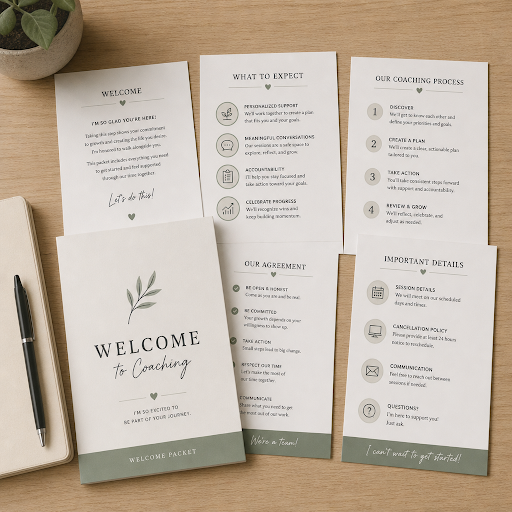
A strong client welcome packet template should feel easy to move through from beginning to end. Start with the warm, human elements, then move into practical instructions and policies.
A simple structure might look like this:
- Welcome message
- About your coaching approach
- Program overview
- Session guidelines
- Communication expectations
- Scheduling and cancellation policies
- Contact information
- First steps checklist
This order helps the client feel welcomed before they encounter logistics. It also makes the document scannable, which matters because clients may return to it later when they need a quick answer.
4. Write a warm welcome message
Your welcome message sets the tone for the coaching relationship. Keep it brief, sincere, and specific to the experience the client is beginning.
You might acknowledge their decision to invest in personal growth, express that you are looking forward to supporting them, and explain how the packet will help them get started. Avoid vague motivational copy that could fit any business. A few grounded sentences are more effective than a long inspirational note.
5. Introduce yourself and your coaching philosophy
Clients do not need your full biography here, but they do need to understand the perspective you bring to the work. Include a short introduction that explains who you support, how you approach coaching, and what kind of client participation leads to the best experience.
For example, a life coach may emphasize reflection, accountability, values-based decision-making, mindset work, or practical action planning. The goal is not to overexplain your method. It is to help the client understand the style of support they can expect from you.
6. Present the coaching program clearly
Use this section to summarize the specific program or package the client has joined. Include the program name, general format, number or rhythm of sessions if applicable, and any included resources or touchpoints.
Keep this aligned with what the client purchased. If you offer multiple coaching packages, create a master client welcome package template and duplicate it for each program. Then adjust the program details so each version is accurate and relevant.
7. Add session guidelines
Session guidelines help clients understand how to participate well. This section can include how to prepare, how to join calls, what to bring, and how to make the most of each session.
For life coaches, practical guidance might include:
- Arrive on time and in a private space when possible
- Review notes or reflections before the session
- Bring questions, updates, or decisions you want to explore
- Be open to honest reflection and agreed-upon action steps
- Save the meeting link somewhere easy to access
These guidelines are not about controlling the client. They are about helping the client show up ready for meaningful work.
8. Clarify communication expectations
Communication boundaries are one of the most important parts of a coaching onboarding packet. Clients should know how to contact you, what channels to use, and when they can expect a response.
Be clear about whether you use email, a client portal, voice notes, messaging apps, or another system. If between-session support is included, explain what that support is for and what it does not cover. Clear expectations protect your energy and help clients feel secure because they know exactly where to go.
9. Include scheduling and cancellation policies
Your client welcome packet should briefly explain how scheduling works and what happens when a client needs to cancel or reschedule. Keep this section concise and consistent with your coaching agreement.
Include key details such as the scheduling link, notice required for cancellations, how missed sessions are handled, and whether there are limits around rescheduling. Do not copy your entire legal agreement into the packet. Instead, summarize the practical points clients need to follow and direct them back to the agreement for full terms.
10. Add contact information
Make your contact details easy to find. Include your preferred contact method, business email, scheduling link, client portal link, or support contact if you use one.
Avoid listing every possible way to reach you if you do not actively monitor those channels. The clearer you are, the less likely clients are to send important questions to the wrong place.
11. End with clear next steps
The final page should tell the client exactly what to do after reading the welcome packet. This is where many templates fall short, leaving clients informed but unsure.
A simple next-steps checklist might include:
- Complete the intake form
- Sign or review the coaching agreement if not already completed
- Book the first session
- Add session dates to the calendar
- Save the coaching contact details
- Review the preparation prompts before the first call
End with reassurance. Let the client know that once those steps are complete, they are ready to begin.
How does the welcome packet fit with the intake form and coaching agreement?
The welcome packet sits between your intake form and coaching agreement as the client-friendly guide to getting started. The intake form gathers information from the client, the coaching agreement documents the formal terms of the relationship, and the client welcome packet explains the practical experience of working together.
Keep each document in its lane. If your welcome packet repeats the entire agreement, it becomes too long. If it tries to collect detailed client history, it starts acting like an intake form. Let the packet focus on orientation, expectations, and next steps.
Customizing your client welcome packet template
A client welcome packet template should save time, but it should never feel generic. Customization is what makes it feel aligned with your coaching business and relevant to the client’s program.
Start with the visual elements:
- Logo: Place your logo on the cover page, footer, or final page without crowding the design.
- Brand colors: Use your main colors for headings, dividers, icons, or callout boxes.
- Fonts: Choose readable fonts that match your brand style and are easy to scan on screen.
- Images or graphics: Use them sparingly so the packet feels polished rather than cluttered.
Then update the operational details:
- Contact information: Check your email, scheduling link, portal link, and social links before sending.
- Program details: Adjust the packet for private coaching, group coaching, VIP days, or longer packages.
- Policies: Make sure cancellation, rescheduling, communication, and response-time details match your current process.
- Coaching style: Reflect your actual tone and approach, whether it is reflective, structured, intuitive, strategic, or a blend.
A good habit is to review your template every time you update an offer. Small changes in program delivery can create confusion if your welcome materials are not updated too.
Design and usability tips that make the packet easier to use
Your client welcome package template does not need to be elaborate. It needs to look professional, feel consistent, and help the client find information quickly.
Use these design principles as you build:
- Prioritize scannability: Use short paragraphs, headings, bullet points, and checklists.
- Keep the layout consistent: Repeat the same heading styles, colors, spacing, and page structure.
- Use plain language: Write instructions the client can understand on the first read.
- Create visual breathing room: Avoid filling every inch of the page with text.
- Highlight key actions: Use callout boxes for scheduling links, deadlines, or first steps.
- Make it simple to save: Give the file a clear name, such as “Welcome Packet – Client Name” or “Program Welcome Guide.”
PDF format is usually best for sending a finished packet because it preserves the design and is easy for clients to download, save, and reference. An editable Canva format is useful for you as the coach because it lets you update brand colors, fonts, logo placement, program details, and policies without redesigning the document from scratch.
If you use Canva, keep a master copy untouched. Duplicate it each time you create a new version for a specific offer or client type.
Common mistakes to avoid
Even a beautiful client welcome packet can create friction if the content is unclear or outdated. Review your template for these common issues before using it in your onboarding process.
- Making it too long: Clients do not need a full operations manual. Keep the packet focused on what they need to begin confidently.
- Using generic copy: Replace vague welcome language with details that match your coaching style, program, and client experience.
- Repeating the entire coaching agreement: Summarize practical policies, but leave full legal or contractual language in the agreement.
- Leaving outdated links or policies: Broken scheduling links, old contact details, or outdated cancellation terms can make the process feel disorganized.
- Using inconsistent branding: Mismatched fonts, colors, and layouts can make the packet feel pieced together instead of intentional.
- Forgetting clear next steps: Clients should never finish the packet wondering what to do next.
A quick review before each new client or program launch can prevent most of these problems.
Using the packet during onboarding
Once your client welcome packet template is ready, decide exactly when and how clients will receive it. The best timing is usually after enrollment is confirmed and before the first session. This gives clients enough time to complete any preparation without feeling rushed.
You can send the packet by email, include it in a client portal, or link it inside your onboarding workflow. In your message, briefly explain what the packet includes and point the client to the most important action, such as completing the intake form or booking the first call.
For a smoother process, create a repeatable onboarding sequence:
- Client enrolls or confirms coaching package.
- You send the welcome packet, agreement, and intake form as appropriate.
- Client completes required forms and schedules the first session.
- You review the intake form before the call.
- The first session begins with both sides clear on expectations.
This workflow keeps the client experience organized and helps you avoid last-minute admin questions.
A ready-to-use option for life coaches
If you do not want to build your client welcome packet template from a blank page, the EmpowerHUB Client Welcome Pack offers a practical starting point designed for coaching onboarding. It includes professionally structured onboarding content, a ready-to-use PDF, and an editable Canva version you can customize with your logo, brand colors, fonts, contact details, program information, policies, and coaching style.
This can be especially helpful if you want a polished client welcome pack without spending hours deciding what to include or how to organize it. You can adapt the content to fit your offer, save the PDF, and use it as part of your onboarding process for new life coaching clients.
Ready to simplify your onboarding materials? Explore the EmpowerHUB Client Welcome Pack and customize it for your coaching business.
FAQ
What should be included in a client welcome packet for life coaches?
Include a welcome message, a short introduction to your coaching approach, program details, session guidelines, communication expectations, scheduling and cancellation policies, contact information, and clear next steps. Keep the focus on helping the client start well rather than explaining every detail of your business.
Should I send the welcome packet before or after the intake form?
Many coaches send both around the same time after the client enrolls. The welcome packet explains the process, while the intake form collects the client’s background, goals, and context. If one action matters most, highlight it clearly in your email.
Can I use the same client welcome package template for every coaching offer?
You can use one master template, but it should be customized for each offer. Private coaching, group coaching, and intensive sessions may have different schedules, communication boundaries, preparation steps, or policies.
Is a PDF or Canva template better?
Use Canva for editing and updating your template. Use PDF when sending the finished version to clients because it is easy to download, share, and view consistently across devices.
Final takeaway
A strong client welcome packet helps your life coaching clients begin with clarity, confidence, and realistic expectations. Build it around the information clients need most, keep the design clean, and customize it so it reflects your actual coaching process. Whether you create your own from scratch or start with a ready-made template, the best packet is one that makes onboarding easier for both you and your client.
About the Author
Michelle is the founder of EmpowerHUB Technologies and an experienced entrepreneur who helps coaches turn their expertise into structured, professional businesses. After building and scaling businesses of her own, she created EmpowerHUB to give new and growing coaches access to practical templates, digital resources, marketing tools, and business systems that make getting started less overwhelming.
Her goal is to help coaches spend less time trying to figure out the business side and more time serving their clients with confidence.
Get Your Free Life Coach Checklist!
Click the button below and take the first step toward the freedom, purpose, and business you’ve been dreaming of.
Your new chapter starts with one simple download.